
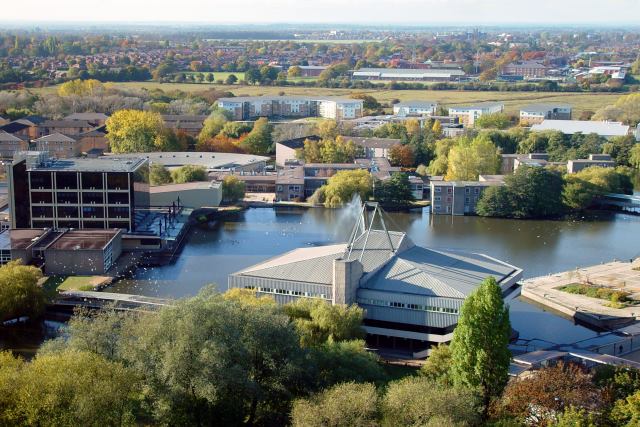
The University of York was founded in 1963 and is one of a handful of universities that have climbed the rankings of top universities so quickly in such a short time. A member of the Russell Group, it ranks 17th in the UK rankings, and the QS World University 2015/2016 places it 103rd. The University of York believes in research-led teaching and in the benefits of its research for people and society. It is no coincidence that it is in the top 10 for the most impactful research according to the Research Excellence Framework 2014 (REF). York has the highest percentage of research rated “world-leading,” and overall 82% of its research is “world-leading” and “internationally excellent.” The university is a pioneer in creating opportunities that boost students' employability, offering them various internship and volunteering programs. It has the highest average score for teaching quality among British universities. The academics whose research helped its high REF ranking also teach at the university. The University of York has won numerous awards in recent years, one of which was University of the Year in 2010. It excels in fields such as archaeology, biological sciences, chemistry, education, history, politics and art history, ranking in the top 10 for these subjects.
York is a small, quiet and safe city with an exceptionally rich history and cultural heritage. Considered one of the most beautiful cities in Europe, it is a popular tourist destination offering many historic sights, the most famous of which are York Minster, the defensive walls around the city, the Jorvik Viking Centre, the National Railway Museum and Clifford's Tower. The city used to be a center for manufacturing railway equipment and confectionery, but today its main source of income is tourism.
Main programs and majors (For a detailed list, ask one of our consultants)
- Accounting and Finance
- Archaeology
- Avionics
- Biological Sciences
- Biomedical Sciences
- Biotechnology
- Business and Management
- Chemistry
- Computer Science
- Computer Systems and Software Engineering
- Criminology
- Ecology
- Economics
- Education
- Electronic Engineering
- Genetics
- German
- Historical Archaeology
- History
- History of Art
- Human Geography and Environment
- Interactive Media
- Italian
- Law
- Linguistics
- Mathematics
- Medical Science
- Medicine
- Midwifery Practice
- Molecular Cell Biology
- Music
- Music Technology
- Natural Sciences
- Nursing
- Philosophy
- Physics
- Politics
- Psychology
- Social and Political Sciences
- Social Policy
- Social Sciences
- Social Work
- Sociology
- Spanish
- Theatre: Writing, Directing and Performance
- Theoretical Physics
Key information
Program length:
3-5 years for bachelor's programs
1-2 years for master's programs
Academic year:
2 semesters - September and January
Start of the year:
September and January (for some programs only)
Application deadline:
October 15 for medicine
January 15 is the recommended deadline for most majors. The final cutoff is June 30, but those applications will not be given priority.
There is no deadline for master's and PhD/doctoral programs, but the university advises applying as early as possible.
Admission requirements:
High school diploma; requirements depend on the major.
For master's programs, a bachelor's degree with a grade at least equivalent to a Lower Second, depending on the major. For doctoral programs, at least an Upper Second.
IELTS
For bachelor's programs, between 6.0 and 7.5, depending on the major. For master's programs, a minimum of 6.0-7.0
Cambridge English: Advanced/Proficiency
For bachelor's and master's programs, between 169 and 185 (C-B), depending on the major.
Scholarships and loans
The tuition fee for bachelor's programs is £9000. The UK government provides student loans with favorable repayment terms. Students begin repaying the loan only once they earn an annual salary of more than £21000. For more information, ask one of our consultants.
Master's programs cost £6450 on average, depending on the program. Taking out a loan for them is harder, but not impossible.
Doctoral programs cost £4052.
Accommodation:
University residence halls cost between £4160 and £7294 per year, depending on the residence and room type. Accommodation in a house or apartment that is not part of the university residence halls costs between £4052 and £4830 per year.