
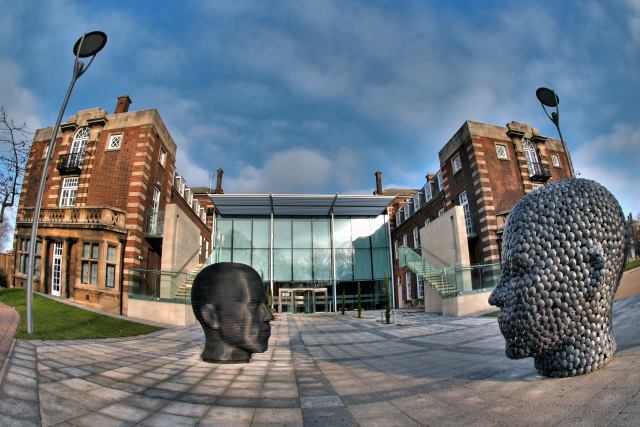
The University of Hull was founded in 1928 as University College Hull, and in 1954 it received its Royal Charter. The Research Excellence Framework 2014 rated 62% of the university's research as internationally excellent. Areas of expertise include social justice, environmental technologies, maritime history, healthcare, 3D visualization and nanotechnology. The university received an award for technological achievement for its discovery of stable liquid crystals, which made LCD displays possible. Another important, world-changing discovery was the first ultrasound scanner for detecting osteoporosis (a bone disease). The university's research is currently focused on new carbon capture technologies. The University of Hull has outstanding technological facilities, including 3D computer visualization and simulation, environmental testing equipment, bioengineering visualization, first-class laboratories and much more. The university's Students' Union is one of the most active in the country, with more than 150 active societies, and in 2012 it won the "Students' Union of the Year" award. It has its own nightclub worth £3.5 million. The University of Hull is ranked 63rd in the UK and 551st in the QS World University Rankings 2015/2016 and is known as "the friendly university".
The university is located in Hull, one of the largest metropolitan cities in the country, in East Yorkshire, where the River Hull meets the Humber. Founded by monks who needed a port for their wool trade, the city was an important trading hub, a port for military supplies, and a fishing and whaling center. Hull suffered severe damage during the Second World War, but in the 21st century major subsidies were poured into its regeneration. Today the city has a rich cultural heritage, and it is no accident that it will be named UK City of Culture in 2017.
Main programs and majors (For a detailed list, ask one of our advisors)
- Accounting
- American Studies
- Archaeology
- Biological and Environmental Science
- Business
- Chemical Engineering
- Chemistry
- Chinese
- Community and Youth Work
- Computer Science
- Creative Writing
- Criminology
- Digital Media
- Drama
- Economics
- Education and Childhood Studies
- Electronic Engineering
- English
- Film and Screen
- Financial Management
- French
- Geography
- Geology
- German
- Health and Social Care
- History
- Italian
- Languages
- Law
- Management
- Marketing
- Mathematics
- Mechanical Engineering
- Medical and Biomedical Engineering
- Medicine
- Music
- Philosophy
- Physics
- Political and International Studies
- Psychology
- Religion
- Social Sciences
- Social Work
- Spanish
- Sport
- Supply Chain Management
Key information
Duration of study:
3-5 years for Bachelor's programs
1-2 years for Master's programs
Academic year:
2 semesters - September and January
Start of the year:
September
Application deadline:
October 15 for medicine
January 15 is the recommended deadline for most majors. The final cutoff is June 30, but those applications will not be given priority.
There is no deadline for Master's and PhD/doctoral programs, but the university advises applying as early as possible.
Admission requirements:
High school diploma with a minimum GPA of 5.3, depending on the major. For Master's and doctoral programs, a Bachelor's or Master's degree, respectively, with a minimum grade of 4.5, depending on the major.
IELTS
For Bachelor's programs, between 6.0-7.5, depending on the major.
Cambridge English: Advanced/Proficiency
For Bachelor's and Master's programs, a minimum of C1-C2 or higher, depending on the major.
Scholarships and loans
The tuition fee for Bachelor's programs is £9,000. The UK government provides student loans with favorable repayment terms. Students only start repaying the loan once they earn an annual salary of more than £21,000. For more information, ask one of our advisors.
Master's programs cost between £5,100 and £19,800, and doctoral programs £4,052. Getting a loan for them is more difficult, but not impossible.
Accommodation:
University residence halls cost between £3,200 and £4,800 per year, depending on the hall and room type. Accommodation in a house or apartment outside the university residence halls costs between £2,600 and £3,400 per year.