
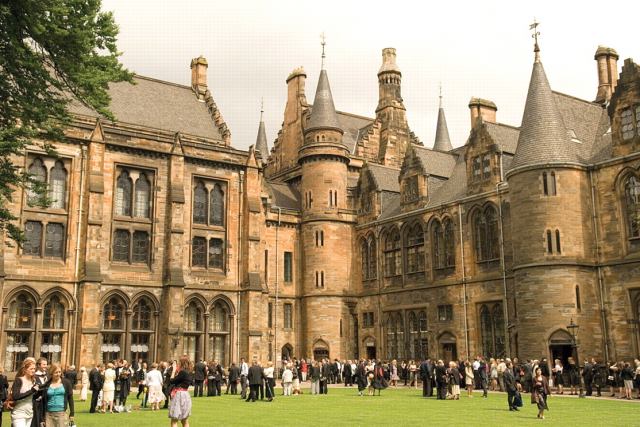
Founded in 1451, the University of Glasgow has been home to great names such as the father of modern economics, Adam Smith; the pioneer of modern television, John Logie Baird; the producer of the series Doctor Who and Sherlock, Steven Moffat; as well as 7 Nobel laureates. Albert Einstein himself gave a lecture there on the theory of relativity. It is a member of the prestigious Russell Group, and the Research Excellence Framework 2014 rated 78% of the university's research as "world-leading" or "internationally excellent". It ranks 4th in the UK for veterinary medicine, is the best in the UK for dentistry, and is in the top 10 for accounting, anatomy, archaeology, geology, medicine, law, psychology, sociology, sports science, veterinary science and more. The university is currently ranked 67th in the QS World University Rankings 2020 and 11th in the UK. It is also the first university in the UK to receive the maximum rating in every possible category in 2019. The University of Glasgow offers Erasmus opportunities, as well as ways to boost students' employability through work placements that are part of the university's majors.
Glasgow is the largest city in Scotland and the third most populous in the whole of the UK. Scottish Opera, Scottish Ballet and the Royal Scottish National Orchestra are based in Glasgow, and overall it is a cultural hub full of galleries, museums and theaters. The population is 593,000, and the student community exceeds 60,000. Glasgow is also known as a City of Music, with around 130 music events every week.
Main programs and majors(For a detailed list, ask one of our advisors)
- Accounting and Finance
- Archaeology
- Biodiversity, Animal Health and Comparative Medicine
- Business
- Cancer Sciences
- Cardiovascular and medical sciences
- Celtic and Gaelic
- Central and East European Studies
- Chemistry
- Classics
- Comparative Literature
- Computing Science
- Dentistry
- Economic and Social History
- Economics
- Education
- Engineering
- English Language
- English Literature
- French
- Geographical and Earth Sciences
- German
- Health and wellbeing
- Hispanic studies
- History
- History and art
- Infection, immunity and inflammation
- Information studies
- Italian
- Law
- Life Sciences
- Management
- Mathematics
- Medicine
- Molecular, cell and systems biology
- Music
- Neuroscience and psychology
- Nursing and health care
- Parasitology
- Physics and astronomy
- Politics
- Psychology
- Russian
- Scottish Literature
- Sociology
- Statistics
- Theatre, Film and Television Studies
- Theology and religious studies
- Urban Studies
- Veterinary Medicine
Key information
Duration of study:
3-5 years for Bachelor's programs
1-2 years for Master's programs
Academic year:
2 semesters - September and January
Start of the year:
September and January (for some Master's programs only)
Admission deadline:
October 15 for medicine, veterinary medicine and dentistry
January 15 is the recommended deadline for most majors. June 30 at the latest, but those applications will not be given priority.
National Admissions Test for Law - January 20; registration deadline January 15.
Deadlines for Master's programs vary depending on the major. The standard deadline is August 28, 2020 for a 2020 start. Please note that the deadline for some majors is considerably earlier. If you are interested in the deadline for a specific major, ask our advisors.
Admission requirements:
Accounting and Finance
High school diploma with a GPA of 5.9, no less than 6 on all state exams, and a 6 in mathematics and in a humanities subject.
Arts
High school diploma with a GPA of 5.9, no less than 6 on all state exams, and a 6 in mathematics and in a humanities subject.
Engineering
High school diploma with a GPA of 5.9, no less than 5.9 on all state exams, and a 6 in mathematics and physics.
Science degrees
High school diploma with a GPA of 5.7, no less than 5.7 on all state exams and subjects in the final year, and a 6 in two science subjects.
Social Sciences
High school diploma with a GPA of 5.9, no less than 6 on all state exams, and a 6 in two humanities subjects.
TOEFL
For Bachelor's and Master's programs, between 90-100, depending on the major.
IELTS
For Bachelor's and Master's programs, between 6.5-7.5, depending on the major.
CAE /CPE
For Bachelor's and Master's programs, between A-B, depending on the major.
Scholarships and loans
Tuition in Scotland is £1,820 for EU and Scottish citizens. Students can apply to have their fees paid by the Scottish Government and, provided they meet certain conditions, they will not have to repay anything after graduation.
Accommodation:
University residence halls cost between £89 and £174 per week, depending on the hall. Private accommodation in a house or apartment outside the university residence halls costs £2,500-£5,500 per year.