
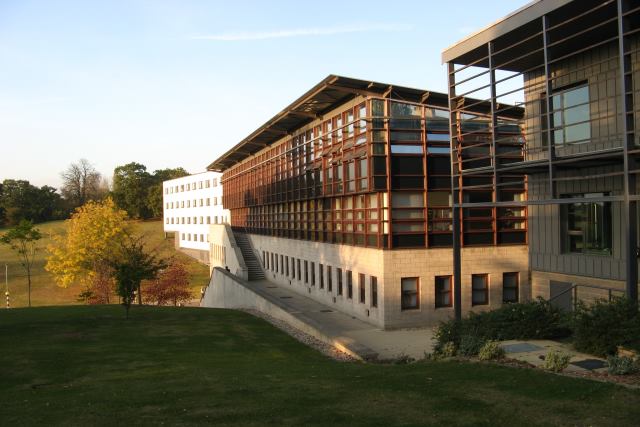
The University of Essex was established in 1964 and is located in the county of Essex, in the East of England. The university has an exceptionally strong research profile, and the Research Excellence Framework 2014 rated 78% of its research as "world-leading" or "internationally excellent". This places it in the UK top 20, 4th for research in the social sciences and 1st for political science. Its School of Computer Science and Electronic Engineering is considered one of the leading ones in the world. It is no accident that in 2005 scientists from the school developed the first autonomous robotic fish, which swam in the London Aquarium. The University of Essex is ranked 34th in the UK and 303rd in the QS World University Rankings 2015/2016. It ranks 6th in the country for art, architecture and design, and is in the top 20 for law and human rights, philosophy, sociology, criminology, psychoanalytic studies, therapeutics and sport. The University of Essex is the only university in the country to receive a Regius Professorship in political science, awarded in 2012 to mark the Queen's Diamond Jubilee. Other awards include ones for "Human Rights" and "Sustainable Development". It is one of the most international universities, with 12,000 students from 130 countries. Teaching methods include lectures as well as seminars, laboratory experiments and practical classes. The university offers unique opportunities for a year-long Erasmus exchange, placement programs and volunteering, and students do not have to pay tuition fees during these activities.
The county of Essex lies on the east coast of the UK and has a long history dating back to ancient times. Most of the county is used for agriculture, but the southern part is a hub for electronics and pharmaceutical companies. The university's main campus is located in Wivenhoe Park, set on 200 acres of land. Life in Essex is calmer but also cheaper, and London is only 50 minutes away by train.
Main programs and majors
- Accounting, Financing and Banking
- Acting and Theatre
- Actuarial Science
- American Studies
- Art History, Architecture and Design
- Biochemistry
- Biological Sciences
- Biomedical Sciences
- Business and Management
- Computational finance
- Computational Science
- Criminolog y
- Drama
- Economics
- Electronic Engineering
- English Language and Linguistics
- European Studies
- Film Studies
- Genetics
- History
- Hotel Management
- Human Rights
- Journalism
- Latin American Studies
- Law
- Liberal Arts
- Literature and creative writing
- Marine Biology
- Marketing
- Mathematics
- Modern languages
- Nursing
- Oral Health Sciences
- Philosophy y
- Physiotherapy and Occupational Therapy
- Politics
- Psychoanalytical Studies and Therapeutic Care
- Psychology
- Social Work
- Sociology
- Sports and Exercise Science
- Sports Therapy
Key information
Duration of study:
3-4 years for Bachelor's programs
1-2 years for Master's programs
Academic year:
2 semesters - September and January
Start of the year:
September and January (for some Bachelor's and Master's programs)
Application deadline:
January 15 is the recommended deadline for most majors. The final cutoff is June 30, but those applications will not be given priority.
There is no deadline for Master's and PhD/doctoral programs, but the university advises applying by July 1 for an October start.
Admission requirements:
High school diploma with a GPA of at least 5.0. Master's admission requires a Bachelor's degree with a minimum grade of 5.0, again depending on the major.
IELTS
6.0 for Bachelor's programs; 6.0-7.0 for Master's/doctoral programs.
TOEFL
76 for Bachelor's programs; 76-100 for Master's/doctoral programs.
Cambridge English: Advanced/Proficiency
169 or higher for Bachelor's programs; 176-190 for Master's/doctoral programs.
Scholarships and loans
The tuition fee for Bachelor's programs is £9,000. The UK government provides student loans with favorable repayment terms. Students only start repaying the loan once they earn an annual salary of more than £21,000. For more information, ask one of our advisors.
Master's programs cost £5,665-£12,500. Getting a loan for them is more difficult, but not impossible. Doctoral programs cost £4,050, depending on the program.
Accommodation:
University residence halls cost between £3,357 and £7,486 per year, depending on the hall and room type. Private accommodation in the city costs £3,300-£5,000.