
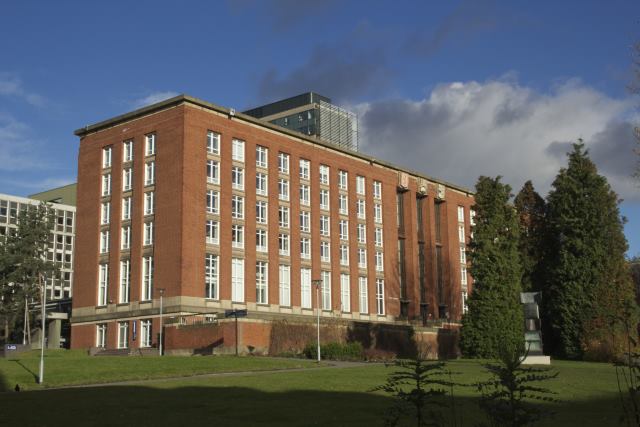
Founded in 1900, the University of Birmingham was the country's first civic university, where students from across the country were admitted on equal terms regardless of their religion or background. Today it is home to around 32,000 students from all over the world. Its alumni include Hollywood and TV stars, radio presenters, athletes and 8 Nobel laureates. The Research Excellence Framework 2014 rated 81% of the university's research as "world-leading" or "internationally excellent", and 87% of it as being of global significance. The University of Birmingham is among the top universities for research in a range of fields, from history and education to chemical engineering and psychology. The university's scientists have found a combination of drugs that increases survival chances in cancer and are currently developing innovative therapies for tuberculosis. Others took part in the ATLAS experiment and witnessed the discovery of the new particle at the Large Hadron Collider. The University of Birmingham is ranked 18th in the UK and 64th in the World University Rankings. It is the best university in the country for tourism, and some of the other subjects in the top 10 include anthropology, archaeology, chemical engineering, computer science, history of art, drama, music, philosophy, physics, sociology and sports science.
Birmingham is the second largest and second most populous city in the UK, located in the West Midlands of England. A medium-sized market town in the Middle Ages, Birmingham gained worldwide fame during the Enlightenment and the Industrial Revolution, when the city became a center of scientific, technological and economic development. It was there that the foundations of modern industrial society were laid, and in 1791 it was considered the first manufacturing town in the world. A mix of modernity, culture and history, the city has a network of canals longer than that of Venice.
Main programs and majors (For a detailed list, ask one of our advisors)
- African Studies
- American and Canadian Studies
- Antiquity
- Archaeology
- Classics
- Drama and Theatrical Arts
- English Literature
- English Language and Applied Linguistics
- History
- History of Art
- Law
- Modern Languages and Cultures
- Music
- Philosophy
- Theology and Religion
- Chemical Engineering
- Chemistry
- Civil Engineering
- Computer Science
- Electronic, Electrical and Systems Engines
- Mathematics
- Mechanical Engineering
- Metallurgy and Materials Engineering
- Physics and Astronomy
- Biosciences
- Earth Sciences
- Environmental Sciences
- Geography
- Geology
- Natural Sciences
- Psychology
- Sports, Exercise and Rehabilitation Sciences
- Dentistry
- Medicine and Medical Sciences
- Nursing
- Pharmacy
- Business
- Economics
- Education
- European Studies
- International Relations
- Marketing and Communications
- Political Science
- Social Studies
- Social Work
- Sociology
Key information
Duration of study:
3-5 years for Bachelor's programs
1-2 years for Master's programs
Academic year:
2 semesters - September and January
Start of the year:
September and January (for some Master's programs only)
Admission deadline:
October 15 for medical majors
January 15 is the recommended deadline for most majors. The final cutoff is June 30, but those applications will not be given priority.
There is no deadline for Master's and PhD/doctoral programs, but the university advises applying as early as possible.
Admission requirements:
High school diploma with a minimum GPA of 5.2
IELTS
For Bachelor's and Master's programs, between 6.0-7.0, depending on the major.
TOEFL
For Bachelor's and Master's programs, between 80-95, depending on the major.
Cambridge
For Bachelor's and Master's programs, between 169-185, depending on the major.
Scholarships and loans
The tuition fee for Bachelor's programs is £9,000. The UK government provides student loans with favorable repayment terms. Students only start repaying the loan once they earn an annual salary of more than £21,000. For more information, ask one of our advisors.
Master's programs range from £6,210 to £9,630, and the MBA costs £21,510. Doctoral programs cost £4,052. Getting a loan for them is more difficult, but not impossible.
Accommodation:
University residence halls cost between £3,884 and £5,580 per year, depending on the hall and room type. Private accommodation in a house costs between £3,100 and £3,750 per year.