
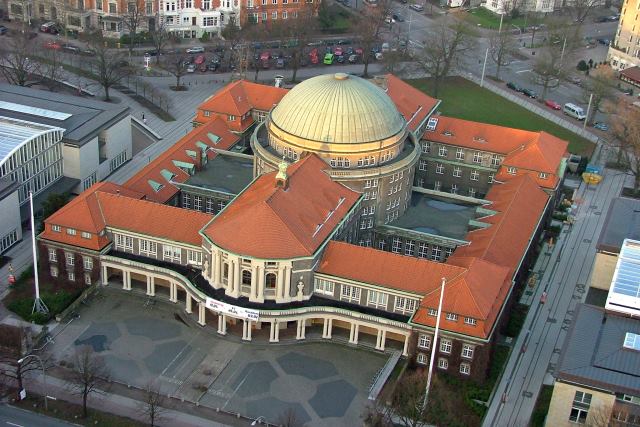
Universität Hamburg is the third largest university in Germany, although it is one of the youngest, founded only in 1919. It ranks 12th in Germany and 192nd in the QS World University Rankings. In 2007 the university received funding for climate research – the Integrated Climate System Analysis and Prediction – as part of the German Excellence initiative. A second project that received funding under the same initiative in 2012 relates to observing atoms and their motion in real time. Other key fields the university specializes in are matter and the universe, neuroscience, multilingualism, heterogeneity and education, infection research, and structural biology. Universität Hamburg counts 3 Nobel laureates, as well as winners of other scientific awards such as the Leibniz Prize and Pour le Mérite. The university has 7 natural science museums and collections, unmatched by those of any other German university.
Located on the Elbe River, Hamburg is the second largest city in Germany. It has the largest port in the country, and because of its enormous importance the city is called the “Gateway to the World.” Hamburg is one of Germany's main industrial centers – it is home to the Airbus plant (the second largest manufacturing plant in Europe and third in the world), the headquarters and production facility of Nivea and Bayersdorf, as well as the headquarters of Philips and Unilever. Hamburg is also a major media center, with many radio and TV stations broadcasting from there. The city's motto is “May the freedom won by our ancestors be preserved by future generations.”
Main programs and majors
-
Ethiopian
-
African Languages and Cultures
-
General Linguistics
-
Althebraistik Bakk
-
English / American
-
movement Science
-
biology
-
chemistry
-
Computing in Science
-
German Language and Literature Educational Sciences
-
ethnology
-
Protestant Theology
-
Finance and insurance
-
Finno-Ugric / Uralic
-
French
-
Sign Language Interpreting
-
sign languages
-
geography
-
geophysics
-
earth sciences
-
story
-
History of Science
-
Historical Musicology
-
timber industry
-
computer science
-
Italian
-
Catalan
-
Catholic Theology
-
Classical Archaeology
-
Classical Philology
-
art history
-
Latin American Studies
-
Food Chemistry
-
Teaching qualification for vocational schools
-
teacher in grammar schools
-
mathematics
-
Media and Communication Studies
-
Medicine
-
Human-Computer Interaction
-
meteorology
-
Medieval Studies
-
Molecular Life Sciences
-
Nanosciences
-
Modern Greek Studies and Byzantine
-
East Asia / focus Japanologie
-
East Asia / focus Koreanistik
-
East Asia / focus Sinology
-
Eastern European Studies
-
pharmacy
-
philosophy
-
physics
-
political science
-
Portuguese
-
Psychology
-
Jurisprudence
-
Software system development
-
Socioeconomics
-
Sociology
-
Spanish
-
Languages and Cultures of India and Tibet
-
Languages and Cultures of Southeast Asia Systematic Musicology
-
Industrial Mathematics
-
Folklore / Cultural Anthropology
-
Economics
-
Pre- and Early History Archaeology
-
The Economy and Culture of China
-
economic computer science
-
Industrial Engineering
-
Business Mathematics
-
dentistry
The following majors conclude with a state examination – dentistry, medicine, law and pharmacy.
Key information
Program length:
3-5 years for bachelor's programs
1-6 years for master's and doctoral programs
Academic year:
2 semesters – Winter and Summer
Start of the year:
October and April (for some programs only)
Application deadline:
July 15 for the Winter intake
January 15 for the Summer intake
There are no fixed deadlines for master's and doctoral programs, but the university recommends applying ASAP. Some international master's programs have an application deadline between February 15 and March 31. These are – Economics; Politics, Economics and Philosophy; International Business Administration; Integrated Climate System Science; Intelligent Adaptive System; Buddhist Studies; South Asia Studies; Tibetan Studies; International MA Program Languages and Cultures of Southeast Asia; Ethiopian Studies.
Admission requirements
High school diploma.
All bachelor's programs are taught in German and therefore require proof of proficiency, but there are master's programs taught entirely in English.
Language requirements
The examination certificate of DSH II (Deutsche Sprachprüfung für den Hochschulzugang, German Language Examination for University Admission)
The Große Deutsche Sprachdiplom (GDS)
Test Deutsch als Fremdsprache (TestDaF) with a minimum of 15
Das Sprachzeugnis der Kultusministerkonferenz, Stufe II (Language Certificate of the Conference of Ministers of Culture, Level II)
Scholarships and loans
In Germany, education is considered a public good to which everyone is entitled, which is why most programs and universities are tuition-free, with minor exceptions for some master's programs. There is, however, a semester fee of €305. This applies to both bachelor's and master's programs.
Accommodation:
Accommodation in Hamburg costs between €250 and €450. Living in Heidelberg can cost around €550-€950 per month.