
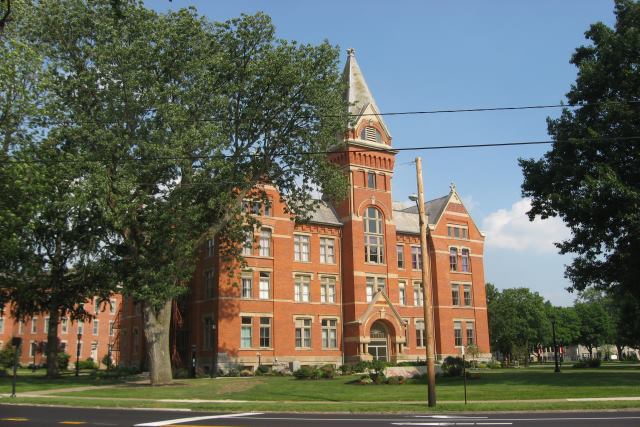
Ruprecht-Karls-Universitaet Heidelberg (University of Heidelberg) is the oldest university in Germany, founded in 1386 when the Pope gave Ruprecht I permission to build a university in the city. It ranks among the best universities in Germany and holds 66th place in the QS World University Rankings 2019.
The university enjoys an excellent, internationally recognized reputation and is one of the major research centers in Europe. Its greatest contribution to society and the world is its research in fields such as the molecular and cellular basis of life, structure and pattern formation in the material world (a field linking physics, mathematics and chemistry), the cultural dynamics of a globalized world, and the regulation of individuals and organizations (a field related to how people and organizations adapt to a changing environment). The university collaborates with many non-university research institutions at the local level and is linked into a worldwide network of research and educational cooperation. The University of Heidelberg places emphasis on research-based education and has excellent doctoral training. It offers about 580 Erasmus programs thanks to its partnerships with more than 270 European universities, as well as exchange programs with another 180 universities around the world.
Heidelberg lies along the Neckar River in southern Germany. It is known for its romantic castle, its fully preserved Baroque old town and the oldest university in the country. The city has a large Bulgarian student community and is to some extent connected with Bulgarian history, as prominent Bulgarian figures and National Revival leaders, among them Petar Beron and Vasil Radoslavov, studied here. In the 19th century many poets and philosophers lived and worked here, earning it the nickname “city of Romanticism.” Today it is a blend of the modern and the old, a scientific and artistic center. It attracts more than 3 million tourists a year and is a must-see destination for Japanese and American tourists.
Main programs and majors
- American Studies
- Ancient History
- Applied Computer Science
- Assyriology
- Biochemistry
- Biosciences
- Byzantine Archaeology and Art Hisotry
- Chemistry
- Chinese Studies
- Christianity and Culture
- Classical Archaeology
- Classical Philology
- Comparative German Studies
- Computational Linguistics
- Cultural and Religious History of South Asia
- Earth Sciences
- East Asian Studies
- East European and East-Central European Studies
- Education Studies
- Egyptology
- English Studies
- Ethnology
- European Art History
- Geography
- German Studies
- History
- Indology
- Interprofessional Healthcare
- Islamic Studies
- Japanese Studies
- Jewish Studies
- Mathematics
- Medical Informatics
- Modern South Asia Languages and Literatures
- Molecular Biotechnology
- Music
- Near Eastern Archaeology
- Philosophy
- Political Science
- Political Economics
- Pre- and Protohistory
- Psychology
- Public Law
- Religious Studies
- Romance Studies
- Semitic Studies
- Slavic Studies
- Sociology
- South Asia History
- Sports Sciences
- Theology
- Translation Studies for Informational Technologies
- Translation
The following majors conclude with a state examination – Dentistry, Law, Medicine, Pharmacy
Key information
Program length:
3-5 years for bachelor's programs
1-6 years for master's and doctoral programs
Academic year:
2 semesters – Winter and Summer
Start of the year:
October and April (for some programs only)
Application deadline:
July 15 for the Winter intake
January 15 for the Summer intake
There are no fixed deadlines for master's and doctoral programs, but the university recommends applying ASAP.
Admission requirements
High school diploma.
All bachelor's programs are taught in German and therefore require proof of proficiency, but there are master's programs taught entirely in English.
Language requirements
The examination certificate of DSH II (Deutsche Sprachprüfung für den Hochschulzugang, German Language Examination for University Admission) – minimum 78% or 2.9. For master's programs in law and the arts – 2.5
The Große Deutsche Sprachdiplom (GDS) or the Zertifikat C2 of the Goethe Institut – minimum bestanden. For master's programs in law and the arts – bestanden.
Test Deutsch als Fremdsprache (TestDaF) with a minimum of 5 in “Schriftlicher Ausdruck” and “Leseverstehen”, and a minimum of 4 in “Mündlicher Ausdruck” and “Hörverstehen”. For master's programs in law and the arts – a minimum of 5 in each section
Das Sprachzeugnis der Kultusministerkonferenz, Stufe II (Language Certificate of the Conference of Ministers of Culture, Level II) – minimum 2.9. For master's programs in law and the arts – 2.5
Scholarships and loans
In Germany, education is considered a public good to which everyone is entitled, which is why most programs and universities are tuition-free, with minor exceptions for some master's programs. There is, however, a semester fee of €142.30. This applies to both bachelor's and master's programs.
Accommodation:
Living in Heidelberg can cost around €700 per month.