
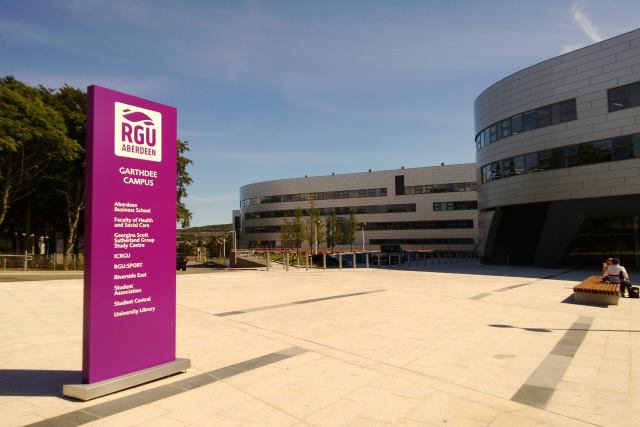
Robert Gordon University was founded in 1729 as Robert Gordon's Hospital by the Scottish merchant Robert Gordon, to educate local residents who were too poor to afford schooling. It gained university status in 1992. The university has always sought to provide an education that prepares students for the professional world, consulting employers when designing its majors and placement programs. Over 90% of all courses offer work placement opportunities. Despite its long history, Robert Gordon University was named the most modern university in the UK in 2012, and in 2014 it was named the top university for graduate employment. 82% of graduates find jobs, with an average annual income of £20,963. The university conducts significant research in a number of fields, including engineering; environmental science; computer science; architecture; art and design; pharmacy; health sciences; applied social sciences; midwifery and nursing; business and entrepreneurship; and information and communication. It maintains good relationships with numerous industrial organizations, government departments and research institutes. It is ranked 63rd in the UK and 701st in the QS World University Rankings 2015/2016. Subjects for which it is among the top 10 universities are medical technology, archaeology, building, tourism, social work and physiotherapy. The university community numbers around 20,000.
Aberdeen is one of the oldest cities in the whole of the UK and the third largest city in Scotland. Known as the Energy Capital of Europe and the Granite City, Aberdeen takes pride in its architecture, rich history, remarkable cultural heritage and lively social life. The city has a population of over 200,000 and a student community of over 30,000. The Complete University Guide named it the safest city in all of Scotland.
Main programs and majors (For a detailed list, ask one of our advisors)
- Architecture, construction & surveying
- Art & Design
- Business, management & Accounting
- Computing
- Engineering
- Health professions
- Information, communication & media
- Laboratory, biomedical & sports sciences
- Law
- Social work & Social Sciences
Key information
Duration of study:
3-4 years for Bachelor's programs
1-2 years for Master's programs
Academic year:
2 semesters - September and January
Start of the year:
September and January (for some Master's programs only)
Admission deadline:
January 15 is the recommended deadline for most majors. The final cutoff is June 30, but those applications will not be given priority.
There is no deadline for Master's and PhD/doctoral programs, but the university advises applying ASAP.
Admission requirements:
For Bachelor's programs, a high school diploma. For Master's and PhD/doctoral programs, a Bachelor's degree with a minimum grade of 4.0.
IELTS
For Bachelor's programs, a minimum of 6.0 with at least 5.5 in each component, depending on the major. For Master's programs, a minimum of 6.5 with at least 6.5 in each component, depending on the major.
TOEFL
For Bachelor's programs, a minimum of 80, depending on the major. For Master's programs, a minimum of 88, depending on the major.
Scholarships and loans
Tuition in Scotland is £1,820 for EU and Scottish citizens. Students can apply to have their fees paid by the Scottish Government and, provided they meet certain conditions, they will not have to repay anything after graduation.
The MBA costs £17,300; the MBA in Oil & Gas Management costs £19,500.
Accommodation:
University residence halls cost between £175 and £200 per week, depending on the hall. Private accommodation in a house or apartment outside the university residence halls costs £5,028-£6,912.