
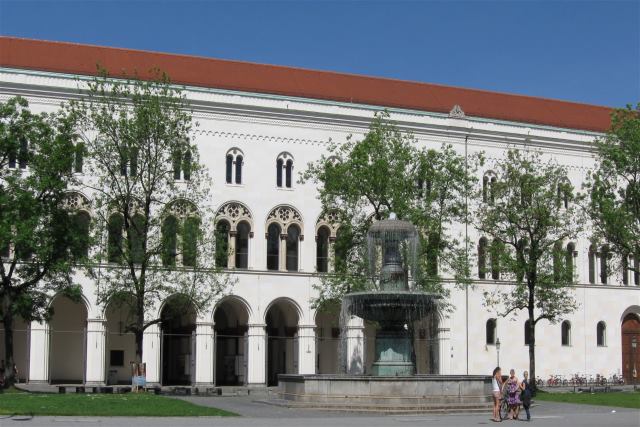
Ludwig-Maximilians-Universität (LMU) München is one of the leading research universities in Europe, with a history of more than 500 years. It was founded in 1472 in Ingolstadt by the Duke of Bavaria-Landshut, Ludwig the Rich, and over the next 500 years it moved twice before settling permanently in Munich. LMU ranks 2nd in Germany and 52nd in the QS World University Rankings. It was selected as a “University of Excellence” in the German government's initiative to promote research at the country's top universities. The university has the best library in the country and the 2nd largest and most prestigious Medical Center. LMU's academic programs place great emphasis on creative thinking, problem solving and research. The research conducted by the university is innovative and pioneering, expanding the boundaries of established knowledge and opening up entirely new horizons yet to be explained. The university has an established reputation and a significant contribution in fields such as ancient studies, nanoscience, the origin of the universe, photonics and quantum optics, molecular biosystems, neuroscience, protein science and translational health sciences. LMU boasts 14 Nobel laureates.
Munich is the capital of Bavaria, located in southeastern Germany, and is known for much more than its football, beer and lederhosen (traditional Bavarian clothing). A lively and culturally rich metropolis, Munich lies 80 km north of the Bavarian Alps. It is the 3rd largest city in the country and a major center for higher education, research, technology and media. With its many galleries and museums, theaters and festivals, art, ballet and music, as well as the world-famous Bavarian State Opera, Munich is much more than the Bavarian capital – it is a major European cultural center and a wonderful place to be a student.
Main programs and majors
- Egyptology and Coptic Studies
- General and Indo-European Linguistics
- General and Comparative Literature
- Ancient Orient
- English language and literature
- Ancient and Orient
- Archaeology: Europe and Middle East
- Business Administration
- Bioinformatics
- Biology
- Buchwissenschaft
- Buddhist and South Asian Studies
- Chemistry and Biochemistry
- Computational Linguistics
- German as a foreign language
- Ethnology
- Protestant Theology
- experimental Physics
- Finno-Ugric Studies
- Geography
- earth sciences
- German studies
- Story
- Greek Philology
- computer science Italianistik
- Japanese Studies
- Communication Studies
- Art History Art, music, theater
- Art Education
- Latinistik
- mathematics
- media computer science
- meteorology
- musicology
- near and Middle East
- Neuro-Cognitive Psychology Teaching / Education Science
- Pharmaceutical Sciences
- philosophy
- Phonetics and Speech Processing
- Physics
- political science
- Prevention, inclusion and rehabilitation (PIR) with hearing impairment
- law
- sociology
- Scandinavian Studies
- Slavistik
- Sociology
- Speech Therapy Statistics
- Theatre Studies
- Theoretical Physics
- Comparative Cultural and Religious Studies
- Folklore / European ethnology
- Economics
- Business Mathematics
- Business Education I
- Business Education I
- Economics
Key information
Program length:
3-5 years for bachelor's programs
1-6 years for master's and doctoral programs
Academic year:
2 semesters – Winter and Summer
Start of the year:
October and April (for some programs only)
Application deadline:
July 15 for the Winter intake
January 15 for the Summer intake
There are no fixed deadlines for master's and doctoral programs, but the university recommends applying ASAP.
Admission requirements
All bachelor's programs are taught in German and therefore require proof of proficiency, but there are master's programs taught entirely in English.
Language requirements
The examination certificate of DSH II (Deutsche Sprachprüfung für den Hochschulzugang, German Language Examination for University Admission).
The Große Deutsche Sprachdiplom (GDS) or the Zertifikat C2 of the Goethe Institut.
The Test Deutsch als Fremdsprache (TEST DAF) with a score of 4 in all 4 examinations (no certificate with a score lower than 4 in one area can be accepted!)
Das Sprachzeugnis der Kultusministerkonferenz, Stufe II (Language Certificate of the Conference of Ministers of Culture, Level II), with the result of 4 x C1.
The Deutsche Sprachprüfung II of the Sprachen- und Dolmetscher-Institut München
Scholarships and loans
In Germany, education is considered a public good to which everyone is entitled, which is why most programs and universities are tuition-free, with minor exceptions for some master's programs taught in English. There is, however, a semester fee of €113, €61 of which is for public transport. This applies to both bachelor's and master's programs.
Accommodation:
University residence halls cost between €200 and €390 per month, depending on the residence and room type. Accommodation outside the university residence halls can cost between €400 and €650.