
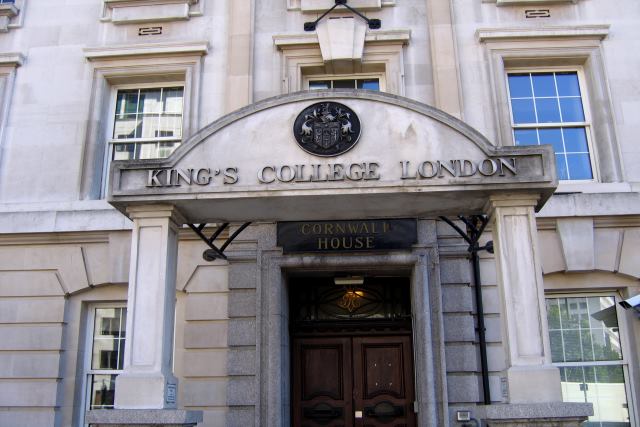
King’s College London was founded in 1829 and is one of the leading educational institutions in the world. A member of the prestigious Russell Group, King’s is ranked 23rd in the UK, while the QS World University Rankings 2015/2016 place it a prestigious 19th in the world. The university has made major contributions to many advances of the modern world, including the discovery of the structure of DNA and research that led to the creation of radio, television, mobile phones and radar. The Research Excellence Framework 2014 (REF) rated 84% of King’s research as world-leading or internationally excellent. It has an established reputation in the humanities, law, health sciences (in the fields of psychiatry, medicine and dentistry) and the social sciences, including international relations. King’s is among the top 10 universities for business and management, dentistry, French, German, law, music, nursing, philosophy and physiotherapy. Many programs offer the opportunity for an Erasmus exchange and an industry placement, and the university also offers language courses. Through its partnerships with over 150 institutions, King’s connects you with the world.
London is the capital and largest city of the UK. The history of London and its landmarks cannot be described in a few sentences, but the city is undoubtedly one of the most sought-after travel destinations in the world. It has it all - pubs or parks, theaters or cinemas, shopping or sightseeing, museums or art galleries - London has something for every taste. Life in the capital, however, may seem a bit expensive for the average student, especially when it comes to housing. The fast-paced lifestyle can both excite you and wear you out, but if you can find a balance between enjoying life and not going broke at the same time, London is the ideal place to be a student.
Main programs and majors
- Accountancy
- American Studies
- Anatomy
- Archaeology
- Artificial Intelligence
- Biochemistry
- Biology
- Biomedical Sciences
- Bimolecular Sciences
- Business
- Byzantine Studies
- Chemistry
- Cinema
- Classical Languages
- Classics
- Comparative Literature
- Computer Science
- Culture
- Dentistry
- Development Studies
- Dietetics
- Digital
- Digital Humanities
- Economics
- Engineering
- English
- Environmental Studies
- European Studies
- Film
- French
- Genetics
- Geography
- German
- Governance
- Greek
- Health
- Hispanic Studies
- History
- Human Biology
- Human Resources
- Intelligent Systems
- International Relations
- Languages
- Latin
- Latin-American Studies
- Law Liberal Arts
- Linguistics
- Literature
- Management
- Marketing
- Mathematics
- Medicine
- Midwifery
- Modern Greek
- Modern Languages
- Molecular Biology
- Molecular Genetics
- Music
- Neuroscience
- Nursing
- Nutrition
- Pharmacology
- Pharmacy
- Philosophy
- Physics
- Physiology
- Physiotherapy
- Politics
- Portuguese
- Psychology
- Religious Studies
- Society
- Spanish
- Theology
- Theoretical Physics
- Urban Studies
- War Studies
- Women’s Health
Key information
Duration of study:
3-5 years for Bachelor's programs
1-2 years for Master's programs
Academic year:
2 semesters - September and January
Start of the year:
September and January (for some programs only)
Admission deadline:
October 15 for medicine and dentistry.
January 15 is the recommended deadline for most majors. The final cutoff is June 30, but those applications will not be given priority.
There is no deadline for Master's and PhD/doctoral programs, but the university advises applying as early as possible.
Admission requirements:
High school diploma with a minimum GPA of 5.5, depending on the major; the university may also require grades between 5 and 5.8 in specific subjects. For Master's and doctoral admission, a Bachelor's or Master's degree with a grade between 4.0 and 5.0, depending on the major.
IELTS
For Bachelor's and Master's programs, a minimum of between 6.5 and 7.0, depending on the major.
TOEFL
For Bachelor's and Master's programs, a minimum of between 93 and 101, depending on the major.
Cambridge English: Advanced/Proficiency
For Bachelor's and Master's programs, a minimum of between 176 and 185, depending on the major.
Scholarships and loans
The tuition fee for Bachelor's programs is £9,000. The UK government provides student loans with favorable repayment terms. Students only start repaying the loan once they earn an annual salary of more than £21,000.
Master's programs range from £2,840 to £23,000, and doctoral programs from £2,300 to £5,250. Some medical and dental Bachelor's and Master's programs (dentistry, dietetics, medicine, midwifery, nursing, physiotherapy) may be funded by the NHS.
Accommodation:
University residence halls cost between £140 and £389 per week, depending on the hall and room type. Accommodation outside the university residence halls can cost between £4,800 and £6,400.