
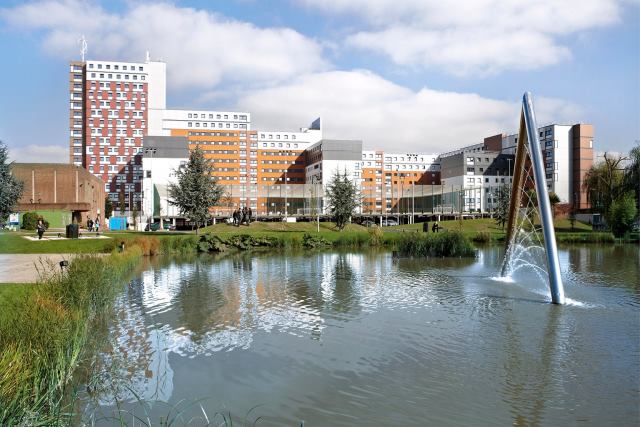
Aston University was founded in 1895 and was one of the first institutions to introduce work placements as part of its programs, as early as the 1950s. It was the first to introduce subjects such as business management, psychology, pharmacy and optometry. Many of its courses include a compulsory or optional work placement, and 70% of students take advantage of this opportunity. The average salary during this placement is £15,000 per year. Ranked 32nd in the UK, the university is known for the high quality of its teaching and research, with the Research Excellence Framework 2014 (REF) rating 80% of its research as world-leading and internationally excellent. In certain fields of research it is a leader in the UK - 3rd for Area Studies, 5th for health sciences and 17th for business studies. Aston University is the best for ophthalmology, and it is in the top 10 for speech therapy, marketing, building and pharmacy. It is in the UK top 10 for graduate employability. The university also offers free language courses to all first-year students in French, German, Portuguese, Spanish, Chinese or Arabic. An impressive 80% of all students take part in some kind of extracurricular activity.
Birmingham is the second largest and second most populous city in the UK, located in the West Midlands of England. A medium-sized market town in the Middle Ages, Birmingham gained worldwide fame during the Enlightenment and the Industrial Revolution, when the city became a center of scientific, technological and economic development. It was there that the foundations of modern industrial society were laid, and in 1791 it was considered the first manufacturing town in the world. A mix of modernity, culture and history, the city has a network of canals longer than that of Venice.
Main programs and majors (For a detailed list, ask an NGB Consulting advisor)
- Accounting and Finance
- Arabic
- Audiology
- Biology, Biological Sciences & Biomedical Sciences
- Business & Management
- Chemistry
- Chinese
- Computing, Computer Science & IT
- Construction Management
- Economics
- Engineering
- English Language
- French
- German
- Human Resource Management
- International Business
- International Relations
- Languages
- Law
- Logistics & Transport
- Marketing
- Mathematics
- Optometry
- Pharmacy
- Physics
- Politics
- Product Design
- Psychology
- Public Policy
- Social Policy
- Sociology
- Spanish
Key information
Duration of study:
3-4 years for Bachelor's programs
1-2 years for Master's programs
Academic year:
2 semesters - September and January
Start of the year:
September and January (for some programs only)
Application deadline:
January 15 for most majors. Final deadline and final rankings - June 30.
There is no deadline for Master's and PhD/doctoral programs, but the university advises applying as early as possible.
Admission requirements:
High school diploma with a minimum GPA of 5.0, depending on the major.
For Master's, doctoral and MBA programs, a Bachelor's degree with a minimum grade of 5.0.
IELTS
For Bachelor's programs, a minimum of 6.0, depending on the major. For Master's and doctoral programs, a minimum of 6.5, depending on the major
TOEFL
For Bachelor's programs, between 78-93, depending on the major. For Master's and doctoral programs, between 93-101, depending on the major
Scholarships and loans
The tuition fee for Bachelor's programs is £9,000. The UK government provides student loans with favorable repayment terms. Students only start repaying the loan once they earn an annual salary of more than £21,000. For more information, ask an NGB Consulting advisor.
Master's and doctoral programs cost £5,500, and the MBA costs £25,250. Getting a loan for them is more difficult, but not impossible.
Accommodation:
University residence halls cost between £111 and £133 per week, depending on the hall and room type. Accommodation in a house or apartment outside the university residence halls costs between £2,700 and £5,250 per year.