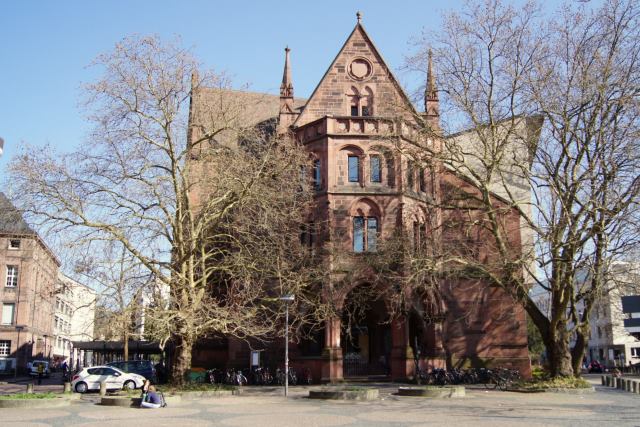
Albert-Ludwigs-Universität Freiburg is one of the oldest German universities, founded in 1457. It ranks 4th in Germany and 121st in the QS World University Rankings. The university is committed to research-based education. As a typical research university, Albert-Ludwigs-Universität Freiburg maintains partnerships with and is a member of a number of international institutions, the most important of which are the European Confederation of Upper Rhine Universities, the League of European Research Universities and the Academic Consortium 21. The university has received a number of national awards for its teaching quality, and in 2009 it won the “Excellent Teaching” award. In 2007 it became one of the country's 9 top universities to receive funding and recognition from the Excellence initiative for its research on complex communication processes within and between cells. With its international research institute, the Freiburg Institute for Advanced Studies, the university strives to consolidate its position as a top research university in the world. Some of the main disciplines the institute focuses on are literature and linguistics, materials, history and the natural sciences, which include a complex mix of biochemistry, molecular cell biology, neuroscience, mathematics and physics. Albert-Ludwigs-Universität Freiburg also runs an amazing program that enriches the learning experience: every semester it organizes lectures, readings, excursions, concerts and courses on various topics, aimed at giving students the opportunity to explore different disciplines.
Freiburg is an old university city located in the southwestern part of the country, close to France and Switzerland. It has been developing since the 12th century to become what it is today – a major commercial, intellectual and ecclesiastical center. The city is known for its medieval cathedral and Renaissance university, as well as for its high standard of living and its environmentally friendly practices. Called “the Green City,” in summer its main means of transport is the bicycle. The city lies in a wine-growing region, and the university even has its own vineyards.
Main programs and majors
- Early German Literature and Language
- Altertumswissenschaften
- Applied Political Science
- Archaeological Sciences
- Biology
- Business Administration
- Educational Planning and Instructional Design
- Chemistry
- German as a foreign language
- Embedded Systems Engineering
- English and American Studies
- Ethnology
- European Ethnology
- French language, literature and culture
- Geography
- Earth sciences
- German Studies
- Story
- Wood and Bioenergy
- computer science
- Interdisciplinary Foundations of Political Science
- International forestry
- Islamic Studies
- Italian
- Judaism
- Catalan
- Catholic Theological Studies
- Classical Philology
- Cognitive Science
- Art History
- Mathematics
- Media Cultural Studies
- Meteorology and Climatology
- Microsystems Technology
- Molecular Medicine
- Musicology
- nature conservation and landscape management
- Nursing Science
- Pharmaceutical Sciences
- Philosophy
- Physics
- Political Science
- Portuguese
- Psychology
- Regio Chimica
- Scandinavian Studies
- Slavistik
- Sociology
- Spanish Language, Literature and Culture
- Sport Science - Physical Activity and Health
- environmental Hydrology
- Economics
- Economics
- Forestry and Environment
The following majors conclude with a state examination – dentistry, medicine, law and pharmacy.
Key information
Program length:
3-5 years for bachelor's programs
1-6 years for master's and doctoral programs
Academic year:
2 semesters – Winter and Summer
Start of the year:
October and April (for some programs only)
Application deadline:
May 15/July 15 for the Winter intake for medicine, pharmacy and dentistry
June 1 – July 15 for the Winter intake for programs with restricted admission
June 1 – October 9 for the Winter intake for programs without restricted admission
January 15 for the Summer intake
For master's and doctoral programs, application deadlines depend on the program.
Admission requirements
High school diploma.
All bachelor's programs are taught in German and therefore require proof of proficiency, but there are master's programs taught entirely in English. The Bachelor of Liberal Arts and Sciences is the only bachelor's program taught entirely in English.
Language requirements
DSH certificate (Deutsche Sprachprüfung für den Hochschulzugang, German Language Examination for University Admission) at level 2 or 3.
The Große Deutsche Sprachdiplom (GDS) at level C2.
Test Deutsch als Fremdsprache (TestDaF) with a minimum of 4 or 5 in each section.
Deutsches Sprachdiplom (DSD) at level 2.
Scholarships and loans
In Germany, education is considered a public good to which everyone is entitled, which is why most programs and universities are tuition-free, with minor exceptions for some master's programs. There is, however, a semester fee of €145. This applies to both bachelor's and master's programs. A student's budget in Germany is about €700-€800 per month.
Accommodation:
A student's budget in Germany is about €700-€800 per month.